3-Line TL;DR
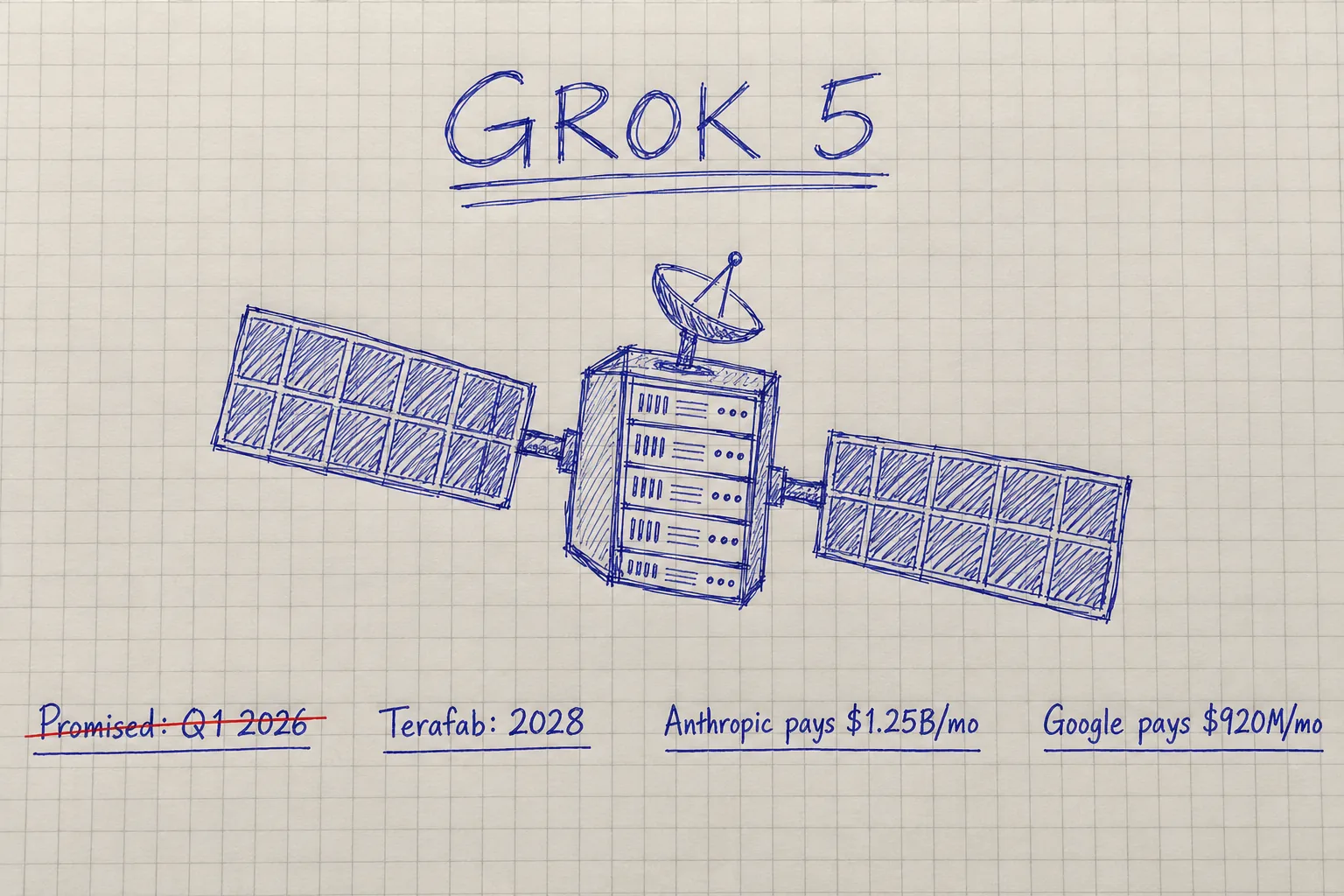
- Not on any calendar that matters now, because Grok 5 missed Musk's "Q1 sometime" promise and is still training behind Grok 4.8 and 4.9
- Terafab and orbital data centers are 2028 projects at the earliest, and SpaceX's own prospectus says parts of them depend on "technologies that do not exist"
- Meanwhile SpaceX rents its Colossus clusters to Anthropic and Google through 2029, so my view stands that a lab behind the leaders should use the best model available today, as Google now does with Claude
Grok 5 was due in Q1 and is now fourth in line
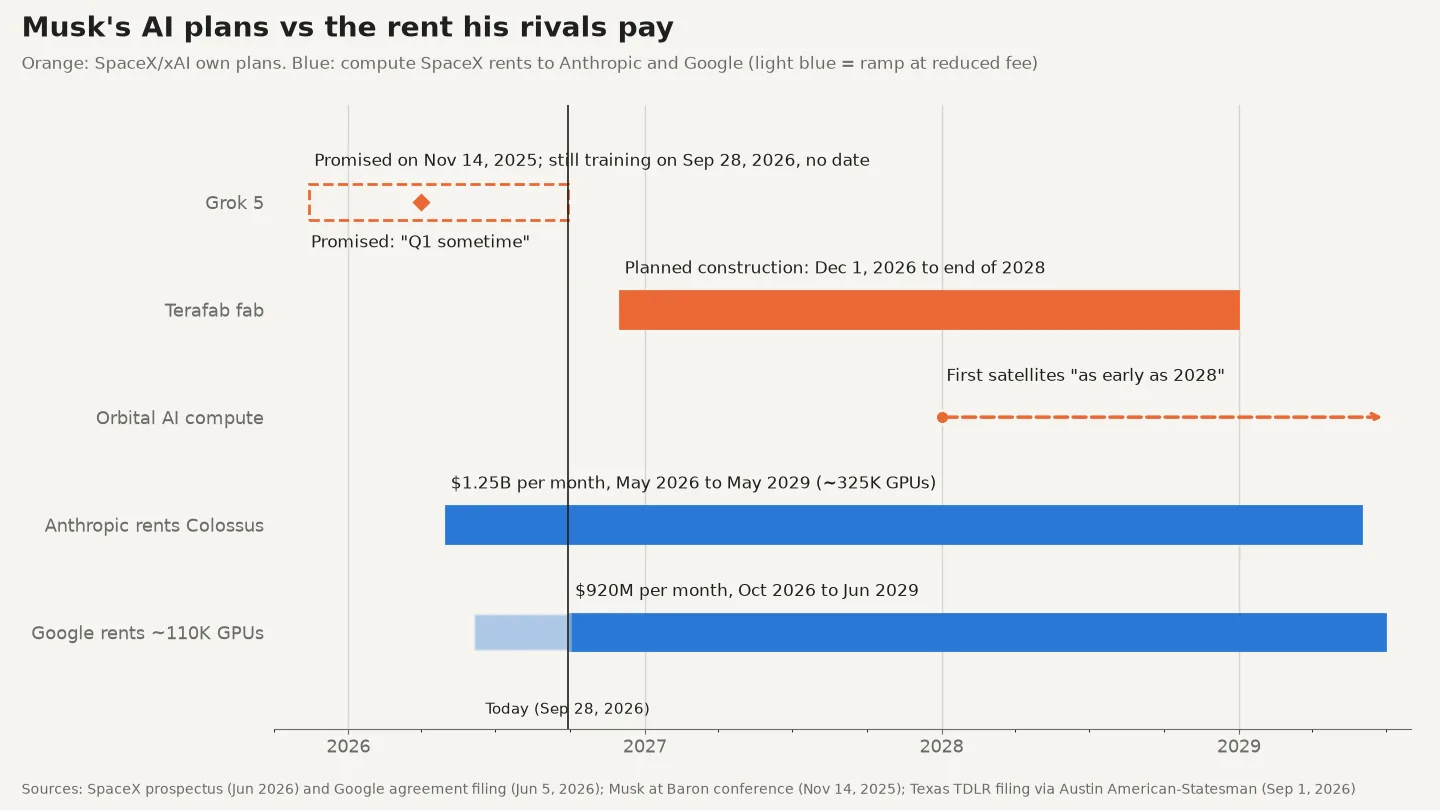
Sources: SpaceX prospectus and Google agreement filing; Musk at the Baron conference; Texas filing via the Austin American-Statesman — chart by HSL
- On November 14, 2025, Musk told Baron Capital investors that Grok 5 would be "the smartest AI in the world by a significant margin on every metric" and would arrive "in Q1 sometime" (transcript)
- He put its chance of reaching AGI at 10% and called it a 6-trillion-parameter model
- Q1 ended without it, and SpaceX's June prospectus says only that Grok-5 "is currently being trained at COLOSSUS II"
- On September 14, Musk laid out a new queue on X (Musk)
- Grok 4.7 "should be roughly on par with Opus 5.0, not 5.1"
- Grok 4.8 is finishing training, and Grok 4.9 "is probably Astra/Fable class"
- Grok 5 is "maybe better than anything," he added, and then "We shall see"
- In ten months, "by a significant margin on every metric" became "we shall see"
- On Artificial Analysis's independent index, Grok 4.7 scores 46 against 58 for Opus 5.5 and 53 for GPT-6 Astra (leaderboard, checked September 28, 2026)
Terafab aims for 1,000 Colossus clusters a year
| Project | Stated goal | Earliest date on record | What SpaceX's own filing says |
|---|---|---|---|
| Terafab chip fab | "One terawatt of compute hardware each year" with Tesla and Intel | Construction Dec 1, 2026 to end of 2028 (Texas filing) | In June, timelines, milestones and spending were "not yet determined"; success "within the expected timeframes, or at all" is not assured |
| Orbital AI compute | Constellations "potentially numbering up to one million satellites" | First satellites "as early as 2028" | Involves "unproven technologies, or technologies that do not exist"; "the conditions of space on such AI infrastructure have not been tested" |
| AI chips for orbit | Terafab to ease the shortage | — | Needs "significantly more than are currently available to us"; a significant portion will still come from outside suppliers |
Sources: SpaceX prospectus, June 2026; construction dates from Texas Department of Licensing and Regulation filings reported by the Austin American-Statesman, September 1, 2026
- SpaceX says Colossus and Colossus II together draw about 1.0 gigawatt
- Terafab's long-term goal is a terawatt of compute hardware per year, so by my arithmetic about 1,000 times today's Colossus every year
- The first real step is smaller, an initial $16.8 billion in Grimes County, Texas (TechCrunch)
- SpaceX's case for orbit is solar power and cooling into the vacuum
- The cooling is the hard part, because in a vacuum heat leaves only by radiation
- ABI Research estimates that one 40 kW rack of 32 GPUs needs an 80 m² radiator, about the size of a pickleball court (IEEE Spectrum)
- Its estimate puts a GPU-year in orbit at least 10 times the cost on the ground, even at an optimistic $44 per kg for Starship
- SpaceX also warns that orbital hardware "will not be easily repaired or upgraded", so one failed part can mean "permanent capacity loss"
Anthropic and Google pay $2.17B a month for Musk's GPUs
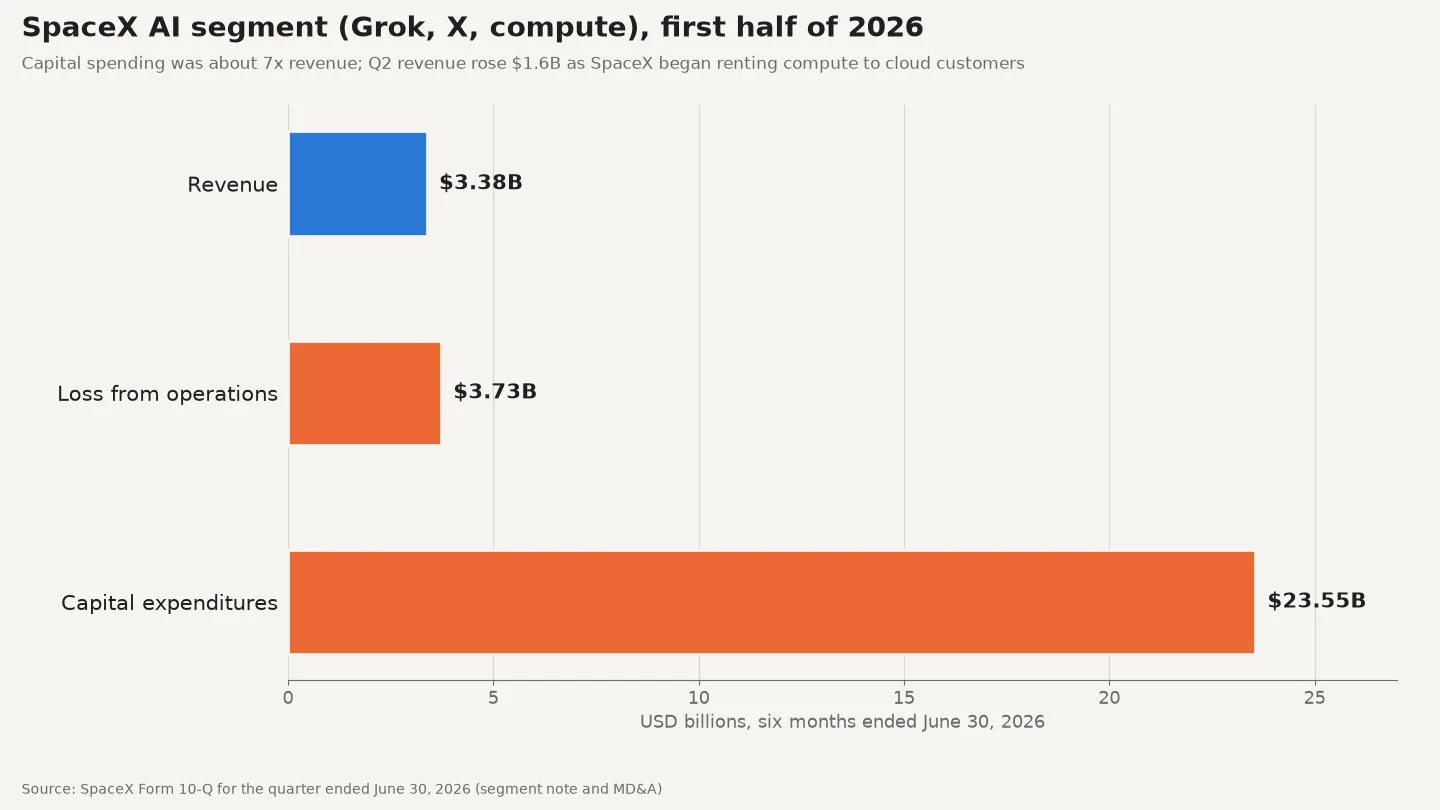
Source: SpaceX Form 10-Q, quarter ended June 30, 2026 — chart by HSL
- In May, Anthropic signed on for about 325,000 Nvidia GPUs across Colossus and Colossus II at $1.25 billion a month through May 2029
- On June 5, Google took about 110,000 GPUs at $920 million a month from October 2026 through June 2029 (filing)
- That is $2.17 billion a month, or about $26 billion a year, from the two labs Grok is trying to beat
- For scale, the whole AI segment, including Grok and X, had $3.2 billion in revenue in 2025
- In the second quarter, AI revenue rose $1.6 billion "as we began to offer cloud services to customers"
- In the first half, the segment spent $23.55 billion on capital projects, about seven times its revenue
- SpaceX says it still has enough capacity for its own training and can reclaim the rest, since both contracts can be ended on 90 days' notice
- It also bought Cursor, the AI coding editor, for an implied $60 billion in stock, closed on August 14 (8-K)
- The compute deal that came with it aims "to improve existing models, including Grok"
- The Colossus that was meant to beat Claude now has Anthropic as its first named tenant
OpenAI and Anthropic run tomorrow's models in-house
- My view is that compute and data matter, but OpenAI and Anthropic are already too far ahead, because they compound with models the public cannot use yet
- OpenAI's own September report fits that view (OpenAI)
- By mid-August, its median researcher used more than $600 of inference a day at API prices, and the 90th percentile more than $7,000
- Its research organization now runs 3.1 agent-workdays for every human workday
- The same report shows Astra-class training runs in its research environments by July 20, six weeks before Astra's September 3 preview
- OpenAI says it has reached an "automated research intern" and aims for an automated AI researcher by March 2028
- Anthropic keeps Mythos 5.1 for vetted US organizations only, though it says Mythos is the same model as the public Fable 5.1 (my earlier look at Mythos)
- On September 15, Google opened Claude Opus 5 to engineers across the company inside its Antigravity platform, on per-user quotas (Dataconomy)
- Google says Gemini "remains our primary and foundational model for internal development"
- It also called its SpaceX GPU deal a short-term answer to Gemini Enterprise demand (TechCrunch), so in 2026 Google uses Anthropic's model and rents Musk's GPUs at the same time
What should a latecomer do?
| Situation | What I would do |
|---|---|
| Choosing a model for work today | Test Grok 4.7 on your own tasks, but plan around the models that lead now; Grok 5 has no date |
| A company behind on AI | Give staff the best available model now, with quotas and data rules, as Google did, and keep building where your own model is strong |
| Tracking Musk's AI plans | Watch only dated milestones, such as Terafab's Dec 1, 2026 groundbreaking, the first orbital compute satellites and whether the Anthropic and Google contracts run to 2029 |
| A country building its own model | Keep going, because in my view the leaders' internal tools widen the gap every month a country waits |
Community Reactions
- An r/singularity reader of the SpaceX prospectus saw Anthropic's $1.25 billion a month as an expensive compute purchase and noted that the filing does not say how it splits between Colossus and Colossus II (Reddit)
- An r/grok poster tied tighter Grok image and video quotas to the Colossus lease because the two happened around the same time (Reddit)
- A reply in that thread countered that Grok 5 is training on Colossus II and that the reason for the quota change is guesswork (Reddit)
- In r/space, a commenter pointed out that vacuum offers no convective cooling, so orbital servers need a lot of radiator area (Reddit)
Q&A (Field Notes)
- Q. When does Grok 5 come out?
- No date has been announced, and Musk's last dated promise was Q1 2026
- Q. Does renting Colossus to Anthropic mean SpaceX is giving up on Grok?
- SpaceX says it kept enough capacity for its own models, and both contracts can be ended with 90 days' notice, so the rent is revenue while Grok 5 trains
- Q. Will data centers in space be cheaper?
- SpaceX believes so in the long run, but its first satellites are 2028 at the earliest and ABI Research estimates a GPU-year in orbit costs at least 10 times as much today
- Q. Is Grok 4.7 good value right now?
- Its $2 / $6 token price is low, but Artificial Analysis measured $2.73 per index task for a score of 46, against $1.82 for 54 from Opus 5.5 at high effort
- Q. Should Korea keep building its own AI models?
- I think so, and the government project is still running with LG AI Research, SK Telecom and Upstage left after the August evaluation (Seoul Economic Daily)