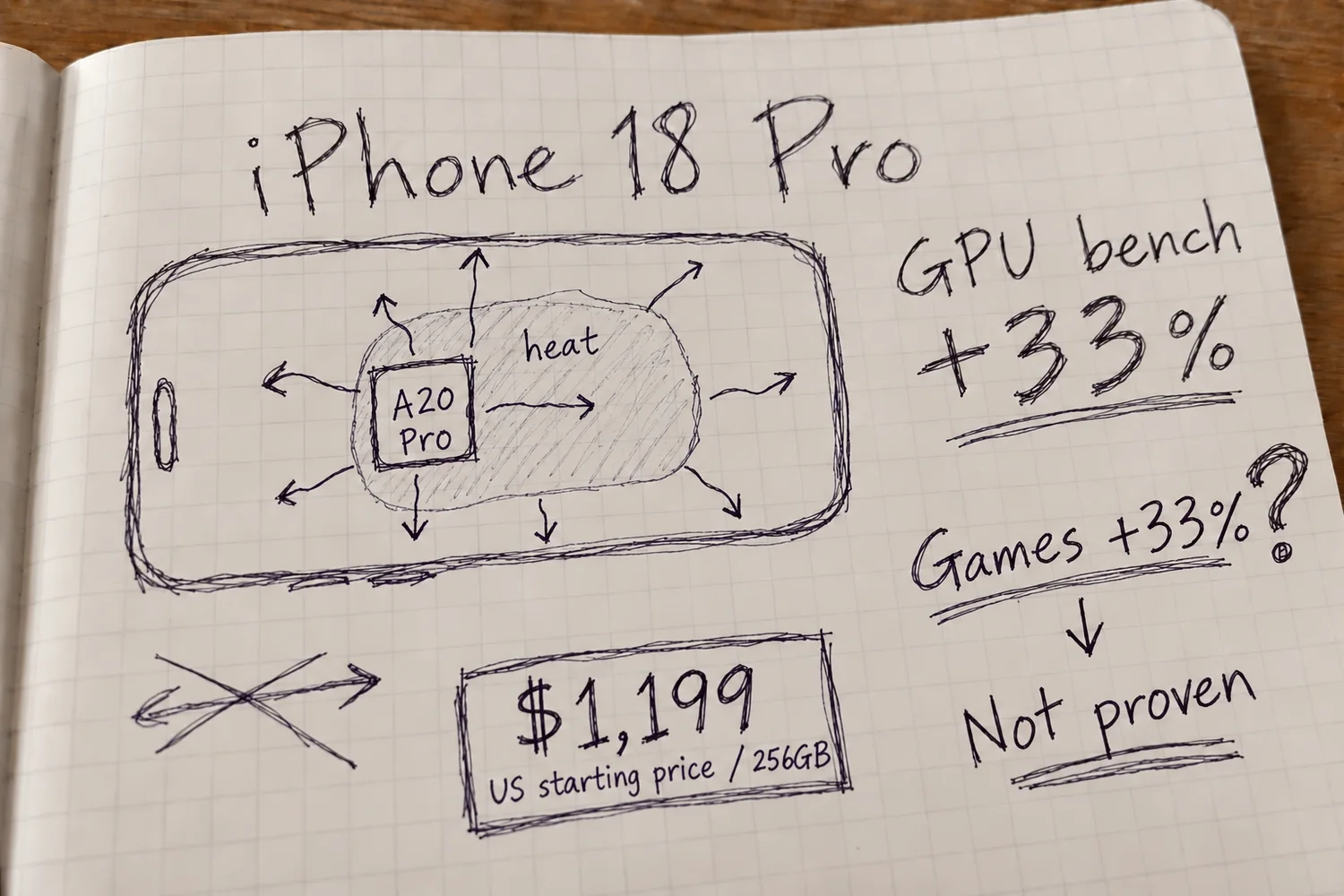
3-Line TL;DR
- iPhone 18 Pro is about 33% faster than the 17 Pro in one published graphics benchmark, which is real but not a promise for every game
- Its 62.8% stress-test stability only compares the phone with its own best run, so it says nothing about speed against another phone
- At $1,199, I would want evidence for the game and the problem I actually have before replacing a 17 Pro
Apple US 256GB starting price, before tax and trade-in credits, and an analysis of published tests rather than our own gaming review
The benchmark is 33% faster, is the game?
- Tom's Guide measured 46.4 fps on the 17 Pro and 61.93 fps on the 18 Pro in 3DMark Solar Bay Unlimited (Tom's Guide review)
- That is about 33% faster in a fixed graphics workload, not the frame rate of any named game
- Apple says its new 7-core GPU is up to 40% faster than the A19 Pro (Apple Newsroom)
- Apple also credits a redesigned vapor chamber with up to 40% better sustained performance
- When a claim says "up to", it is describing the luckiest day
- A game capped at 60 fps stays at 60 fps however fast the GPU gets
| Published measurement | 17 Pro | 18 Pro | What it means |
|---|---|---|---|
| Solar Bay Unlimited average | 46.4 fps | 61.93 fps | About 33% faster in this test |
| Wild Life Extreme stress stability | 61.1% | 62.8% | Retention up 1.7 percentage points |
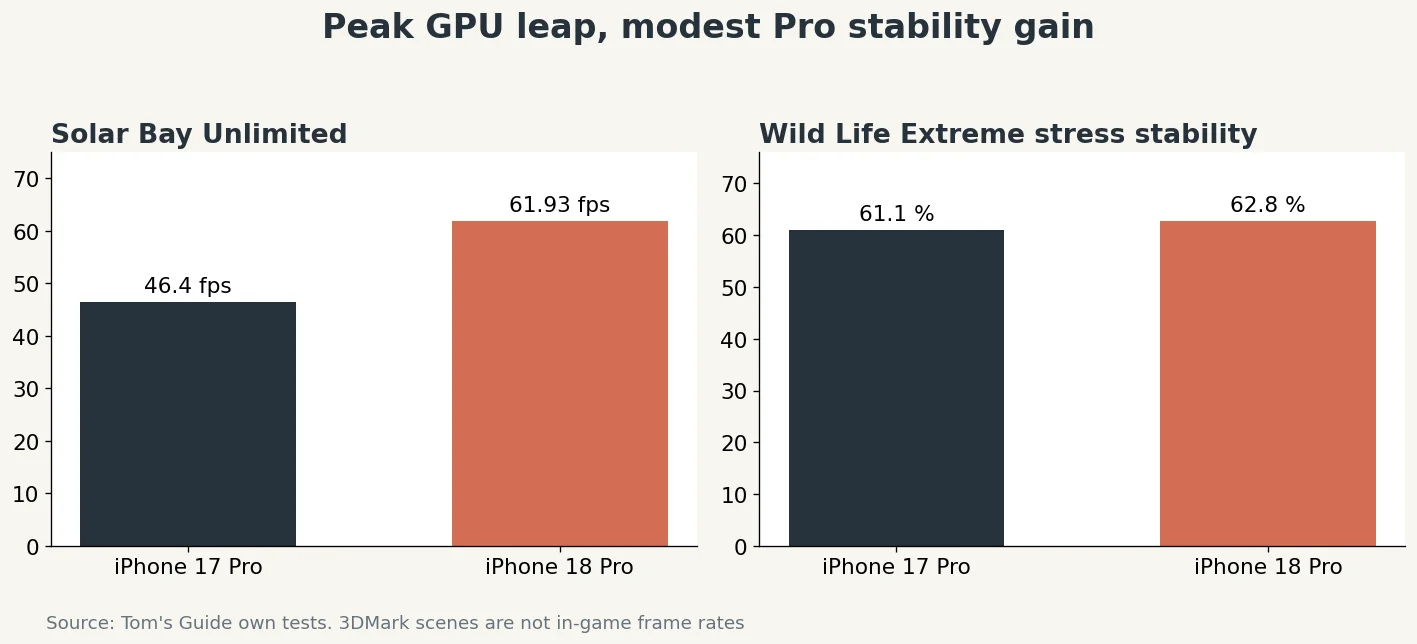
62.8% is how well it holds on, not how fast it is
- UL defines stability as the worst loop divided by the best loop, times 100 (UL explanation)
- It compares a phone with its own best run, not with the phone next to it
- Picture one device falling from 100 to 60 and another from 150 to 90, with made-up numbers
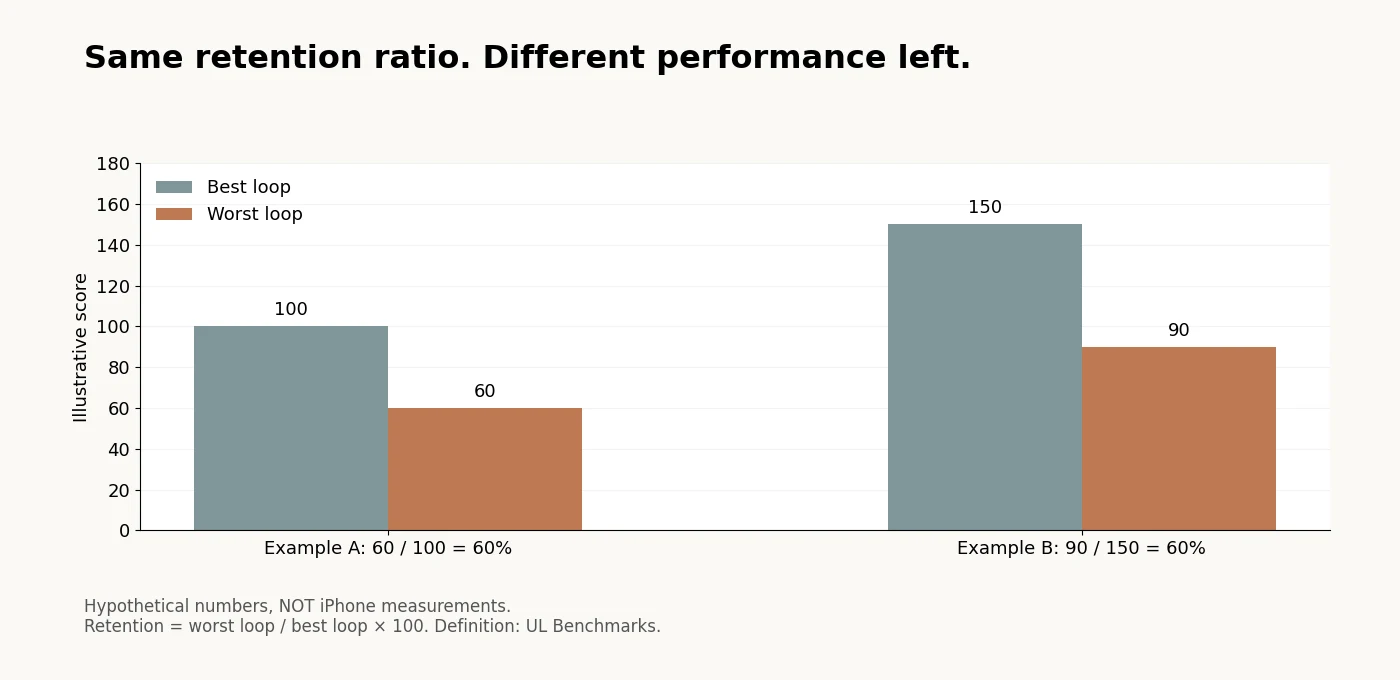
- Both keep 60%, yet 90 is still faster than 60
- So 61.1% versus 62.8% cannot prove that long-session speed barely improved
- Multiplying Solar Bay fps by Wild Life stability does not invent a sustained frame rate either
- The calculator will happily do it, because nobody told it these are two different tests
- The Pro Max climbs from 65.2% to 79.4%, but cooling headroom is not included in Family Sharing
Write down the complaint before spending $1,199
- Apple lists the 256GB 18 Pro from $1,199 in the US (Apple Store)
- Name the complaint the new phone should fix before you spend it
| Current complaint | Evidence to look for |
|---|---|
| The game will not offer the frame-rate mode you want | Support for that game, version and device |
| Frame rate drops later in a session | Long runs at the same settings, brightness and room temperature |
| Heat or battery drain is the real problem | Temperature, power or battery data next to the frame rate |
- For a happy 17 Pro owner, this benchmark alone is a weak case to replace the phone
- For an older-phone owner with a specific problem, it is a lead worth following
- Wanting a new phone is a perfectly good reason on its own
- Just do not make 33% carry the whole justification
Community Reactions
- An r/iphone commenter argued that spare performance keeps a phone useful for years, citing a 13 Pro Max still in use, which is a longevity argument rather than an 18 Pro gaming result (Reddit comment)
- Another commenter said speed has long been enough and that battery life and cameras drive their upgrades instead (Reddit comment)
Q&A (Field Notes)
- Q: Does 61.93 fps mean a demanding game will hold 60 fps?
- No, it is Solar Bay's average, and each game's settings, cap and sustained behavior need their own measurement
- Q: Does 62.8% stability prove the phone runs cooler?
- No, retention is not a temperature reading, so it needs thermal and performance data alongside it
- Q: Should I pick the Pro Max for gaming because of its better stability?
- It is worth comparing, but absolute game performance, size and battery still decide the purchase