OpenAI DevDay 2026: One Day of News, a Month of Things to Try
DevDay felt substantial because models, agents, developer tools and collaboration improved together: all 25 announcements, their rollout limits, and why Sol stands out to me.
By: HSLPublished: Updated:
3-Line TL;DR
This was a substantial DevDay, with improvements to the model, the tools that execute work, and the places where people share the result
OpenAI's official recap has 25 named announcements, covered below from Sol and Dots to developer APIs, plugins, collaboration, subscriptions and enterprise purchasing
GPT-6.1 Sol is still my personal highlight, but the larger appeal is how much more work the whole setup can handle, with some features live and others in preview or still coming
Sol makes everyday work more interesting; Ultrafast buys speed
GPT-6 Sol left me disappointed, and Astra feels expensive to run casually, so a more capable everyday model is exactly the update I wanted
OpenAI reports GPT-6.1 Sol improving DeepSWE 1.1 by 6.4 percentage points over the previous Sol's best result, and AutomationBench by 4.8 points at medium effort
These are maker-reported coding and business-workflow evaluations, which give me a reason to try it rather than a hands-on verdict (Sol announcement)
Model
Input
Cached input
Output
GPT-6 Sol
$2
$0.20
$10
GPT-6.1 Sol
$2
$0.10
$10
GPT-6 Astra
$10
$1
$50
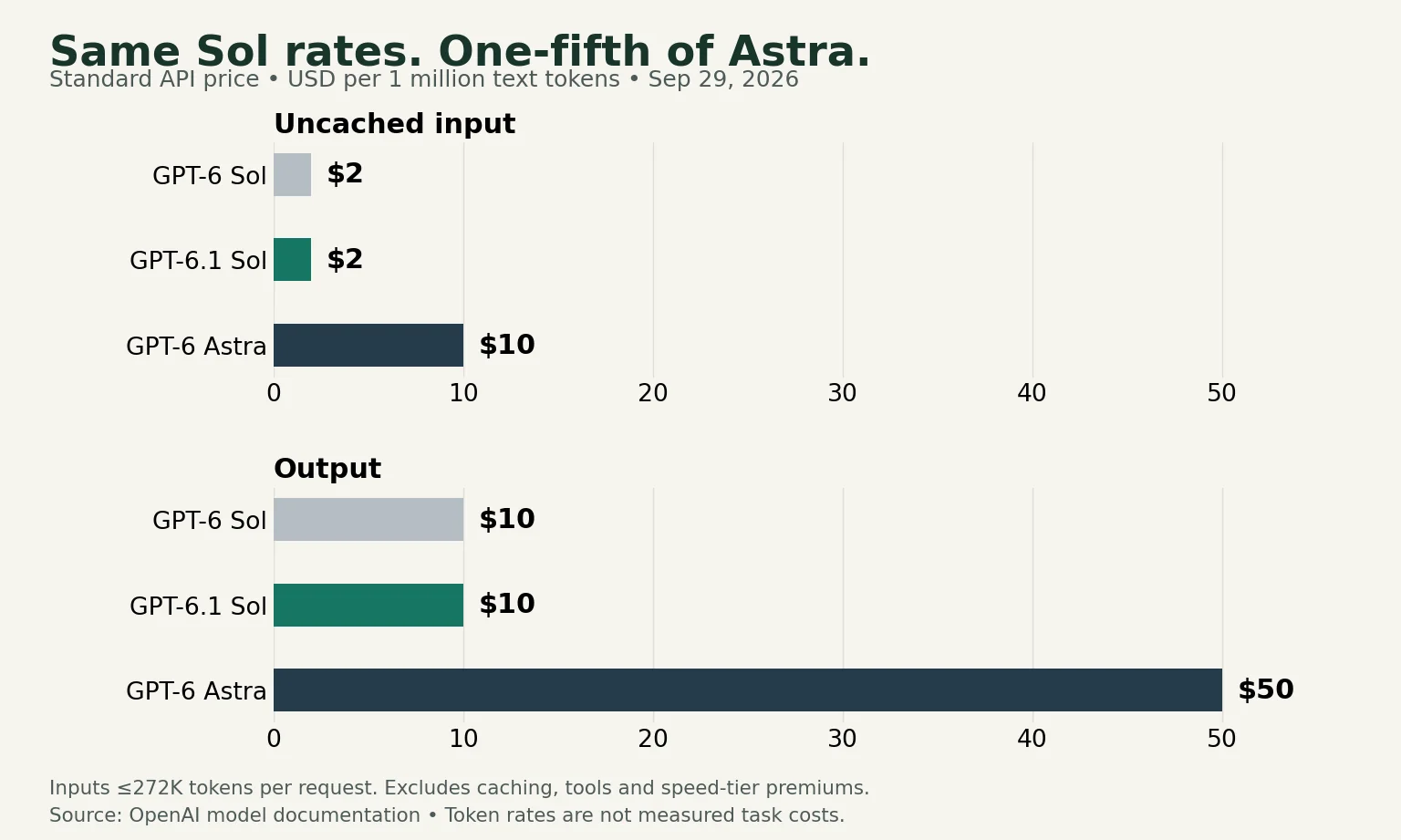
Sources: official model docs for GPT-6 Sol, GPT-6.1 Sol and GPT-6 Astra; USD per million text tokens, standard API processing, checked September 29, 2026
Sol 6.1 keeps the ordinary rates and halves cached-input pricing, with standard input and output at one-fifth of Astra's rates
The table uses requests with at most 272K input tokens and excludes tools and processing premiums; above that threshold the full request has double input/cache rates and 1.5 times output rates
Sol 6.1 launches in Work, Codex and the API for the listed paid plans, while ordinary Chat support is still pending
Ultrafast adds premium speed, with OpenAI advertising up to 8× token generation in Codex, reaching 300 tokens/second, and up to 6× in the API (Launch recap)
Astra Ultrafast is available in the API and in Work/Codex on Pro 500 and Enterprise, while Sol 6.1 Ultrafast is coming later
The API has its own pricing and rate limits, so this is a speed option for work where waiting costs enough to justify it (Ultrafast docs)
A faster answer is useful, although I would still prefer not to buy faster corrections
Dots gives ongoing work somewhere to continue
Dots are Astra-powered agents with their own cloud computers, persistent context and access to connected apps, reachable through ChatGPT, Slack or Teams (Dots announcement)
The point is being able to keep a project moving across conversations instead of explaining the same background every morning
Availability begins with Pro and Business Premium in eligible markets, with an admin-enabled beta for Enterprise, Edu and Healthcare
Background proactive research is read-only, while actions follow permissions and approval rules
OpenAI is also piloting specialist dots with organizational identities and working on Microsoft Agent 365 integration
I like the direction, provided the agent brings back useful progress instead of another queue of things to approve
Dots conversations do not count against ChatGPT usage, but Work and Codex tasks they start still consume the usual allowance
OpenAI agent execution integrated with AWS resources and infrastructure
Limited preview; inference and data remain inside AWS
This is a large part of why the event felt useful to me: writing code, running it, reviewing it and maintaining it all received attention
Decisions API is the routing-related announcement I meant, with predefined answers rather than a promise of automatic Sol/Astra switching inside Codex
Codex already feels quick to bring new capabilities into the workflow, and this batch strengthens that impression
Its integrated gpt-image-2 generator is another personal favorite, although it is an existing feature rather than a new image-model launch at this DevDay (Image generation)
Moving between writing, code and images in one place matters to me more than another isolated demo
Start automations when a connected app reports a change
Based on the proposed events specification; requires a supporting integration
A project-board update can now be the trigger for work, rather than another item someone has to copy into a prompt
Connected-app access for Site visitors is read-only and requires approval; it cannot be reused by background scheduled tasks (Enterprise release notes)
This is more interesting than adding another chat command because the connection can become part of the actual app people use
Space, Pages and meetings make the team side substantial too
Private Safety Processing for automated safety review without human access to protected content
Private Inference, using confidential computing, is a separate preview planned for this fall
The sign-in launch names 16 usage partners, including Devin, Notion, Vercel, T3, OpenClaw and Dactyl, while Marketplace starts with 32 partners including Adobe and Figma (Full announcement list)
External plan usage is particularly appealing because it lets the same subscription support more of the tools I already use
It also means several apps can spend the same allowance, which is a good reason to set limits before introducing them to each other
My overall verdict is that this DevDay was packed with useful changes, with Sol as my first experiment and the broader workflow improvements giving it somewhere useful to work
Some features are rolling out gradually or depend on plan, region and admin settings, so a launch announcement does not mean every account has every switch today
Community Reactions
In the Sol launch discussion, one reader sees a competitive option if the advertised improvements hold up (Reddit)
Another cautions that being near Astra does not establish equality across benchmarks (Reddit)
Q&A (Field Notes)
Q. Is everything listed available now?
No, Sol Ultrafast, collaborative slides, mobile page editing and Private Inference are still ahead, while Decisions API and Bedrock Managed Agents start in limited preview
Q. Is Dots an unlimited Astra subscription?
No, conversations and executed work have different accounting, and Work/Codex tasks still use the normal allowance
Q. Does Sign in with ChatGPT make partner apps free?
No, eligible AI use can draw from Plus/Pro, while the partner may still charge for its own service
Q. What would I try first?
Sol on work that disappointed me with GPT-6 Sol, followed by Codex cloud/review and one narrowly defined Dots responsibility
Q. Was a new image-generation model announced?
The integrated image generator is part of why I like the workflow, but this recap does not establish a new image-model release