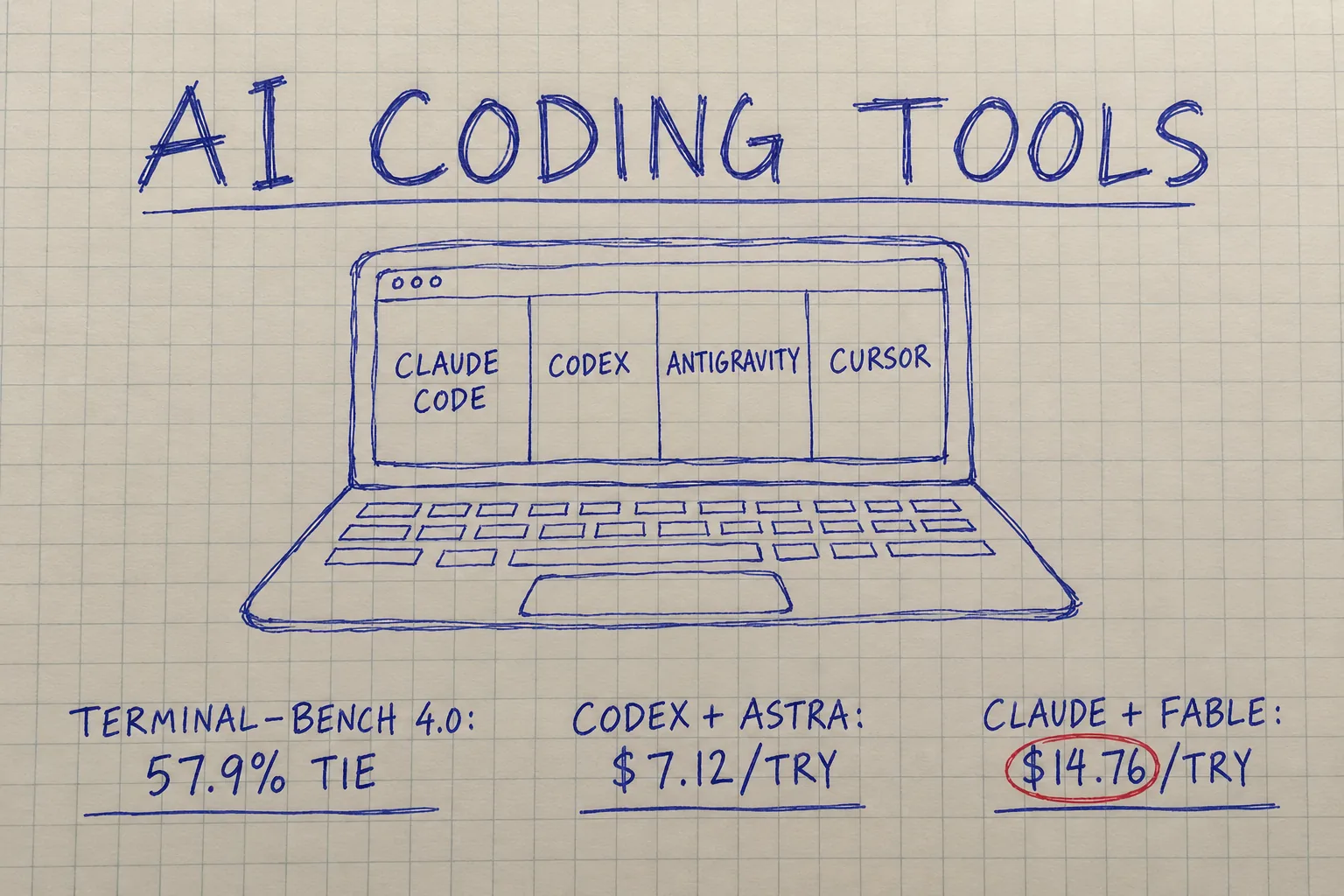
3-Line TL;DR
- In my use, Claude Code has the stronger AI and Codex the more finished tool, and both start at $20 a month
- On the public Terminal-Bench 4.0 board they tie at 57.9%, but Codex with GPT-6 Astra spent $7.12 per attempt to Claude Code's $14.76 with Fable 5.1
- Antigravity, Cursor and Muse Code cost the same or less, and each one comes with a catch
Four tools want $20, Meta wants $5
| Tool | Entry paid plan | Higher tiers | Models on the plan |
|---|---|---|---|
| Claude Code | Claude Pro $20 | Max from $100 | Opus 5.5 and Sonnet 5.5; Fable 5.1 can bill extra credits |
| Codex | ChatGPT Plus $20 | Pro from $100 | GPT-6 Astra, Sol and Luna |
| Antigravity | Free, or Google AI Pro $19.99 | Ultra $99.99 / $199.99 | Gemini 3.1 Pro and 3.8 Flash, Claude 4.6, gpt-oss-120b |
| Cursor | Pro $20 | Pro+ $60, Ultra $200 | Grok 4.7 and Composer 2.5 pool; other makers at API price |
| Muse Code | Everyday $5 | High $15, Power $50 | Muse Spark 1.3 |
US monthly prices before tax, checked September 29, 2026: Anthropic, OpenAI, Google, Cursor, Meta
- OpenAI estimates 5–45 local Codex messages per five hours on Plus with GPT-6 Astra, or 350–3,000 with the lighter Luna
- The top of the Astra range is nine times the bottom, so the real number lives in a usage dashboard
- Muse Code's $5 plan promises 10–50 prompts every five hours, and the $50 plan 20 times that
- Cursor's own pricing page expects daily agent users to spend $60–$100 a month in total
- The $20 on the price tag is where the bill starts
Claude Code and Codex tie at 57.9%, but not on cost
- Terminal-Bench 4.0 gives a coding agent 66 hard terminal tasks and runs each one five times (tbench.ai)
- Each score belongs to a tool and a model together, so it tests the pair
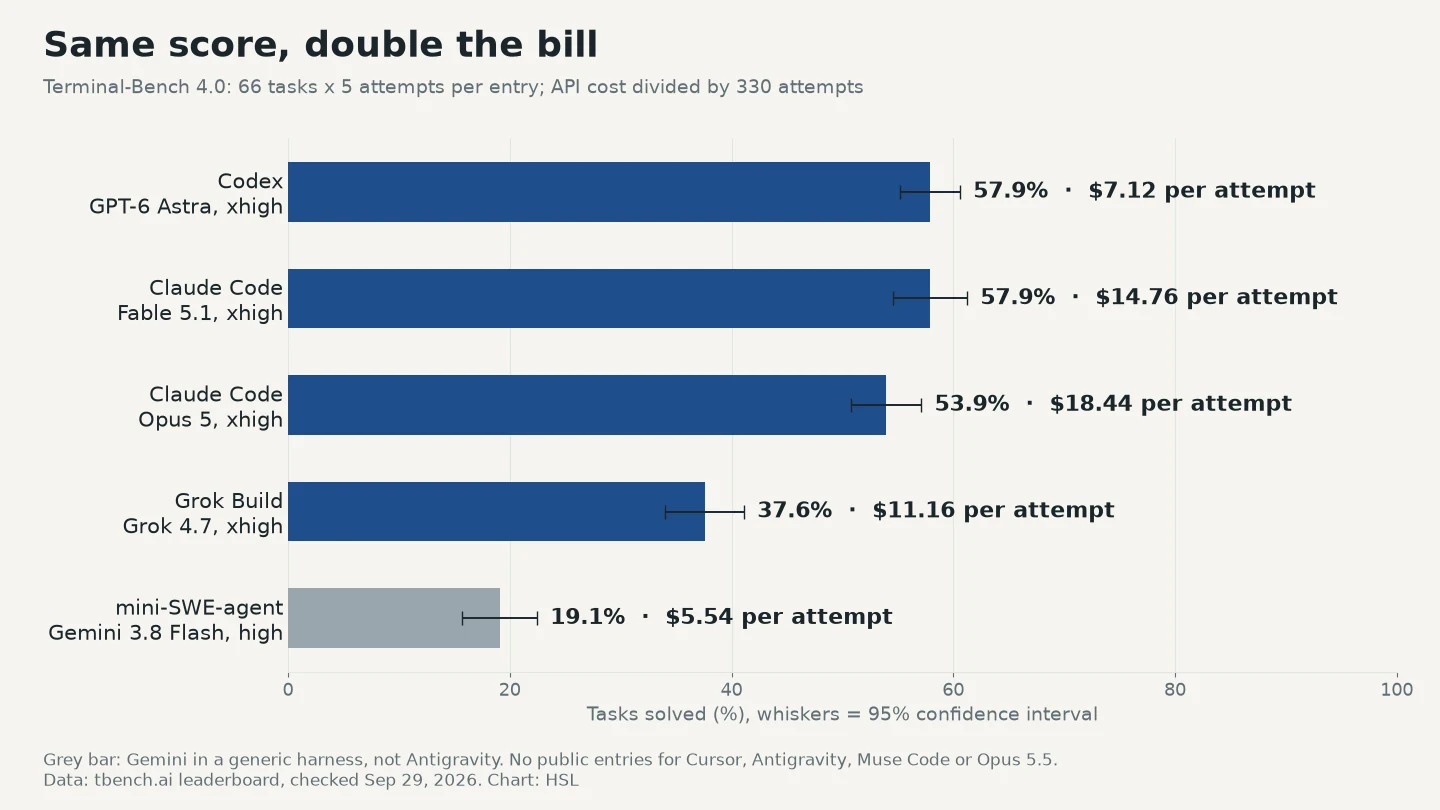
Data: Terminal-Bench 4.0 leaderboard, 330 attempts per entry, checked September 29, 2026; cost is total API spend divided by attempts — chart by HSL
- At xhigh effort, both pairs solved 191 of 330 attempts
- Codex spent $7.12 per attempt and Claude Code $14.76, so the same score cost twice as much
- At max effort Codex edges ahead at 58.2%, inside the error margin
- Anthropic reports its newer Opus 5.5 at 66.4% in its own run, which the public board has not listed yet (Anthropic)
- The same page says benchmark margins have become a less reliable guide to real-world differences, printed right above that table
- In my own use, Claude Code still writes the better code, and Codex is the more finished tool around it
- I explained that move to Opus 5.5 with a same-prompt test in my Astra vs Opus notes
- Codex Plus lists the web, CLI, IDE extension and iOS, plus SSH remote connections and mobile remote control (OpenAI)
- Claude Code covers remote work too, with cloud sessions and Remote Control on Pro and above (Anthropic)
Antigravity is free, and its Claude is still 4.6
- Every individual Antigravity plan, free included, lists Gemini 3.1 Pro, Gemini 3.8 Flash, Claude Sonnet and Opus 4.6 and gpt-oss-120b (Google)
- Paying $19.99 for Google AI Pro raises the limits and leaves the model list unchanged
- Claude Code already runs Opus 5.5, so the free Claude here is a few versions behind
- In my use Antigravity was fast and good value, but less finished overall
- The 2.0 app had no multilingual support and no way to open a project on a remote server
- Its Remote Control, added on August 20, works the other way round and lets a browser drive the session on your own computer (Google)
- The 2.0 changelog adds a WSL connection on Windows, but no SSH connection to another machine (changelog)
- Codex already lists that as SSH remote connections on the $20 Plus plan
- Gemini 3.8 Flash scored 19.1% on Terminal-Bench 4.0 in a generic harness, a score for the model in someone else's harness
Cursor now sells Grok first
- SpaceX completed its purchase of Cursor on August 14 (SEC 8-K)
- Cursor Pro has two usage pools, one for Grok 4.7, Grok 4.6, Grok 4.5 and Composer 2.5, and one for other makers' models (Cursor)
- The Grok pool gets "significantly more included usage", while Claude and GPT draw from the other pool at their API price
- The model with the biggest allowance now has the same owner as the editor
- Grok 4.7 scored 37.6% on Terminal-Bench 4.0 in SpaceXAI's Grok Build, about 20 points behind Codex and Claude Code
- Cursor itself has no entry on that board, so that gap says nothing about the editor
- Pro includes Cloud Agents, so remote work is covered
- I have not used Cursor, so this section comes from published material only
Muse Code costs $5 and grades itself on an older test
- Muse Code is Meta's terminal coding agent, running Muse Spark 1.3 since September 2 (Meta)
- Meta's scorecard compares it with GPT-5.6 Sol and Opus 5, the generation before GPT-6 Astra and Opus 5.5
- Its coding row uses Terminal-Bench 2.1, where it scores 88.8%
- That number cannot be set beside the 58% scores above, which come from version 4.0
- Against Astra and Opus 5.5, the table has nothing to say
- Meta also says Muse Spark 1.3 uses about 25% fewer tokens than 1.2 in its engineers' comparisons
- I have not used Muse Code either, so the $5 plan is the easiest way to check it yourself
So which one gets the $20?
| If you want | Start with | Why |
|---|---|---|
| The strongest code | Claude Code, Pro $20 | My pick for output; Opus 5.5 leads Anthropic's own chart |
| The most finished tool, lower cost per task | Codex, Plus $20 | Same 57.9% at half the cost per attempt; web, CLI, IDE, iOS and SSH |
| Free and fast | Antigravity, free plan | Gemini 3.1 Pro and Claude 4.6 at $0; no multilingual support or remote-server projects in my use |
| To stay in the Cursor editor | Cursor Pro plus a spending cap | Large Grok pool; Claude and GPT bill at API price |
| The cheapest trial | Muse Code, $5 | No independent Terminal-Bench 4.0 result yet |
- Run one real task from your own repo in two tools and compare the diffs, not the demos
- Codex, Claude Code and Cursor all sell extra usage past the plan, so set a cap before the first long run
Community Reactions
- A developer trying Opus 5.5 for daily coding said Astra xhigh still caught subtle architecture gaps in one async-runtime project, while its usage cost pushed them toward Claude for routine work (Reddit)
- In an r/claude thread, some users found Opus 5.5 clearer and more efficient after moving from Codex, while another reported surprising mistakes, all as individual impressions (Reddit)
- A Cursor user kept returning to Composer 2.5 for implementation and used a stronger model to plan, despite trying Grok 4.7 (Reddit)
Q&A (Field Notes)
- Q. Is Claude Code better than Codex?
- They tie at 57.9% on the public board, I prefer Claude Code's code, and Codex spent half as much per attempt
- Q. Can I get Opus 5.5 cheaper through Antigravity?
- No, the newest Claude that Antigravity lists is Opus 4.6
- Q. Can I still use Claude or GPT in Cursor?
- Yes, from the other-models pool at each model's API price
- Q. Is Muse Code's 88.8% better than Codex's 58.2%?
- No, those come from Terminal-Bench 2.1 and 4.0, two different tests
- Q. Can Antigravity open a project on a remote server?
- Not in the 2.0 app I used, and its Remote Control only drives your own computer from a browser